N is for nougat
What is it?
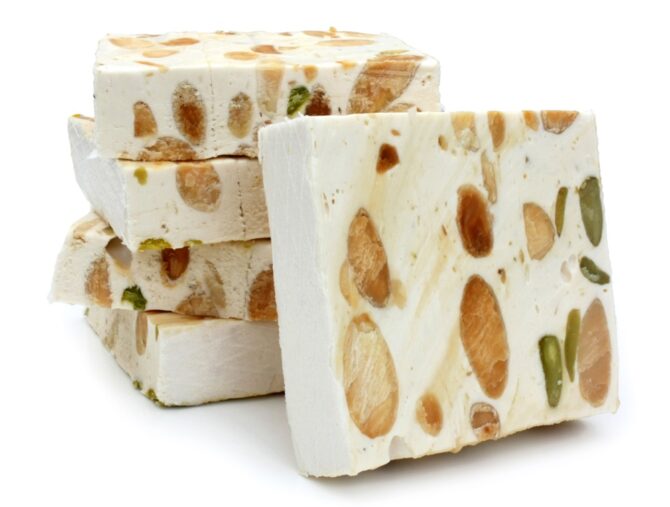
Nougat is a confection of sugar or honey, roasted nuts (most commonly almonds, walnuts, pistachios and hazelnuts), whipped egg whites and occasionally candied fruit.
How do you say it?
Noo-gah. The word comes from the Occitan word nogat, which derives from the Latin nux gatum (nut cake).
Where’s it from?
The earliest known recipes for a nougat-like confection appear in 10th-century medical and culinary manuscripts from Baghdad, where it was called nāṭif. They describe a honey-and-egg-white preparation studded with nuts. Some schools of thought suggest nougat actually dates back to the honey and nut cakes of Roman times, but it seems that it was under Islamic rule that the whipped egg white technique was invented.
In the early 8th century, Arab conquerors brought nougat to the Iberian Peninsula. By the 16th century, Spanish cookbooks and even the great writer Cervantes mention turrón, made with honey, almonds and egg whites. Before long, it made its way to southern France via the Mediterranean trade routes and took root in Provence. Local lore credits agronomist Olivier de Serres (1539–1619) with promoting almond cultivation in the region, enabling almonds to supplant walnuts in the recipe. By the early 17th century, texts such as the Trésor de santé (1607) mention nogat as a Provençal speciality.
Today, famously, Montélimar is the epicentre of French nougat, a reputation it cemented back in 1701, when Louis XIV’s grandsons, Louis Duke of Burgundy and Charles Duke of Berry, were offered a white nougat heading homeward from Spain. The gift sparked royal interest in Montélimar’s moreish sweet treat which in turn made it popular amongst society at large.
At the turn of the 20th century, Montélimar mayor Émile Loubet (who went on to become President of France) championed nougat abroad, presenting it to crowned heads and foreign dignitaries. And then in 1968, the opening of the A7 autoroute really put Montélimar on the map, as travellers stopped at Europe’s largest motorway service area to stock up on nougat.
Why is nougat so famous?
In Provence, nougat is an integral part of the Thirteen Desserts traditionally served at Christmas. Montélimar nougat has also inspired artistic references, notably in the Beatles’ song Savoy Truffle (“creme tangerine and Montélimar”).
Where can I find out more?
Your best bet is to head to Montélimar itself and visit the Musée du Nougat at Arnaud Soubeyran, the oldest working nougat factory in town. It offers an in-depth look at traditional nougat-making, with audio-guided tours and a charming tea room. Alternatively, the expansive Palais des Bonbons, du Nougat et des Souvenirs combines confectionery history with interactive exhibits, including a working nougat workshop, toy museum and vintage Route Nationale 7 experience, making it especially popular with families.
And of course, there are the nougat houses themselves. In 2003, the Nougatiers’ Federation obtained PGI for ‘Nougat de Montélimar, which guarantees artisanal methods and regional authenticity. Today, approximately a dozen artisanal houses in Montélimar uphold these traditions, collectively producing around 4,500 tonnes of nougat annually and employing some 300 workers. Beyond the classic versions, chefs experiment with candied fruits, chocolate coatings, lavender infusions and frozen preparations.
Where can I buy it?
In the UK, there are a number of places you can order it online. Chez Roger in Edinburgh sells traditional soft Montélimar nougat by the house of Diane de Poytiers, handcrafted in Montélimar, in store and online for delivery across the UK. Yorkshire-based Roberts & Speight also stocks Diane de Poytiers Nougat, again deliverable across the UK. Similarly, Le Vacherin Deli also delivers UK-wide from its London-based deli where you can find Reflets de France Soft White Nougat, a classic Montélimar recipe studded with grilled almonds and pistachios.
For the sweet-toothed of America, ChefShop offers nationwide shopping of Arnaud Soubeyran’s Nougat Tendre de Montélimar and Market Hall Foods in Seattle also ships to all States and stocks Suprem’ Nougat Montélimar by artisan producers G. Savin.
And can I make it at home?
Well yes and no. Obviously, it won’t be authentic Montélimar nougat and you presumably don’t have hundreds of years of savoir-faire under your belt. But there’s no harm in trying. Here’s the recipe…
Traditional Montélimar Nougat Recipe
Make approx. 1.2 kg
Ingredients
- 300 g lavender or all-flower honey
- 500 g caster sugar
- 150 ml water
- 2 large egg whites
- 150 g blanched, roasted almonds
- 50 g shelled pistachios (optional)
- 1 tsp vanilla extract
- Rice paper sheets (optional)
- Cornstarch (for dusting, optional)
Method
1. Toast the almonds and pistachios in a 160°C (320°F, Gas 3) oven for 10–12 minutes until golden and fragrant. Keep warm to prevent hardening the nougat when added.
2. Gently warm the honey in a heavy-bottomed pan to 125°C (257°F), using a sugar thermometer. This can take 10–15 minutes. Do not let it caramelise.
3. In a separate saucepan, dissolve sugar in water and heat to 145°C (293°F). Use a thermometer and do not stir once sugar has dissolved.
4. While heating syrups, begin beating egg whites in a stand mixer until stiff peaks form.
5. Slowly drizzle the hot honey into the egg whites while mixing on medium-high speed. This will create a glossy, meringue-like base.
6. With the mixer still running, gradually add the hot sugar syrup. Mix vigorously for 10–12 minutes, until the mass thickens and pulls slightly from the bowl’s sides.
7. Fold in vanilla, warm almonds and pistachios. Stir by hand with a sturdy spatula or dough hook to avoid breaking the nuts.
8. Line a rectangular pan with rice paper or parchment. Spoon in the nougat, smooth the top with a damp spatula and add a second rice paper sheet.
9. Allow the nougat to cool at room temperature for 4–6 hours or overnight before slicing into bars or squares.
10. Wrap pieces in wax paper or cellophane. Keep in an airtight tin, away from humidity. Best consumed within 2–3 weeks. As if you’ll be able to resist…
Top tip
- Use the highest-quality honey possible as its flavour is a defining feature of the finished product.
- Maintain precise temperatures – too low and the nougat won’t set, too high and it will be brittle.
- Work quickly when incorporating nuts; the nougat becomes stiffer as it cools.
Looking for more French food and drink content?
In our magazine we offer a whirlwind tour of the best gastronomic destinations. Discover La Belle France’s renowned markets, quirkiest food festivals, most indulgent restaurants and foodie experiences.
Share to: Facebook Twitter LinkedIn Email
More in alphabet, Food alphabet, nougat
Related Posts