
New Baguette Index reveals where to find France’s cheapest loaf
Most of us shop around for a holiday, a sofa or a new phone. But brothers Charles-Eric and Louis-Marie Lorin took bargain hunting to another level, using a chatty AI assistant called Brigitte to ring more than 5,000 bakeries across France.
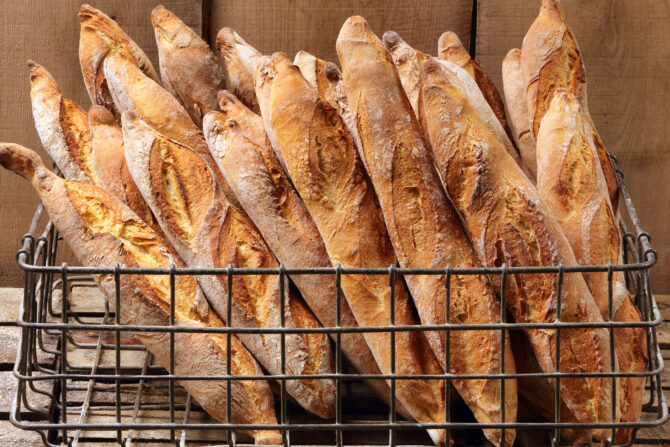
The brothers, who work in tech, programmed Brigitte to ask one simple question: how much do you charge for a baguette tradition? The answer? Around €1.30 for France’s best-known loaf (not the cheaper, mass-produced version – more on that in a moment).
Over five weeks, Brigitte made 11,190 calls, reaching 5,173 bakeries in 146 communes across metropolitan and overseas France. Of 2,770 completed conversations, 1,638 prices made it through the researchers’ vetting process. The results showed that a baguette tradition typically costs around €1.30, with prices ranging from just 80 cents to €1.95. Tours topped the table for affordability, averaging €1.14, followed by Limoges, Bègles, Clermont-Ferrand and Nîmes, all below €1.19.
At the other end of the scale, the highest prices cropped up not in obvious tourist hotspots but in affluent residential communes. A baguette tradition averaged €1.37 in Neuilly-sur-Seine, €1.35 in Chamalières and €1.33 in both Saint-Cloud and Boulogne-Billancourt. Paris as a whole averaged €1.32, although prices varied markedly between arrondissements: the 3rd was the priciest at €1.38, closely followed by the 8th and 16th at €1.37, while the 12th proved the best-value arrondissement at €1.21.
Not every French baguette is a tradition. The standard loaf is usually sold simply as a baguette and isn’t made to the same strict rules. The two are clearly labelled, so you’ll know what you’re buying – but if in doubt, ask for a tradition rather than just a baguette. Under France’s 1993 bread decree, pain de tradition française must be made principally from breadmaking wheat flour, water and salt, and fermented with yeast, natural leaven or both. It cannot contain ordinary additives or have been frozen during production. The artisanal skills and culture surrounding the baguette were added to UNESCO’s Representative List of the Intangible Cultural Heritage of Humanity in 2022.
Brigitte uncovered a couple of other surprises, too. Bigger baguettes were not necessarily more expensive, with little correlation between size and price. And while some supermarket and bakery chains undercut independent boulangeries, the premium names often charged more, with Paul averaging €1.32, Maison Kayser €1.37 and Le Grenier à Pain €1.38.
The differences may only be measured in centimes, but they soon add up. According to the figures, a household buying two baguette traditions a day would spend around €134 more a year in Paris than in Tours. A family buying from an independent artisan rather than a low-cost supermarket could pay around €234 more.
The brothers hope the Baguette Index will become a living resource, with customers and bakers invited to submit new prices and corrections. In the meantime, it offers a fascinating snapshot of France through one of its most everyday purchases.
Lead photo credit : Shutterstock
Share to: Facebook Twitter LinkedIn Email
More in Baguette, Boulangerie
Related Posts