
How truffle farming began in France
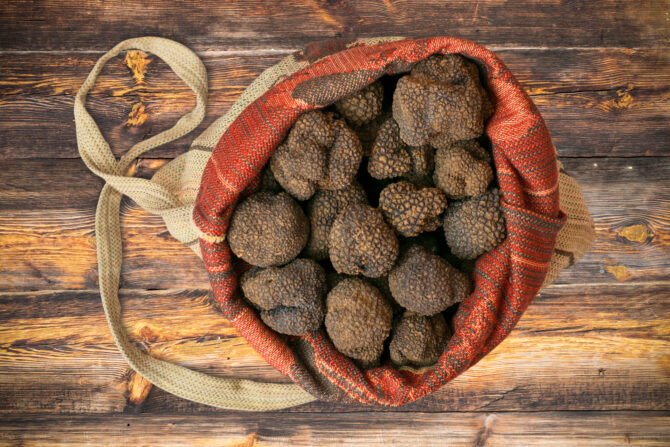
Pierre Mauléon is not a household name – which is odd when you consider what is often laid at his door: the beginnings of truffle farming in France.
Born in 1744, he was a miller in the Loudun area of what is now the Vienne department. Around 1790, in the hamlet of Grand-Ponçay at Beuxes, he is said to have sown acorns taken from truffle-producing oaks in nearby lime-rich ground and, some years later, he found truffles growing there – a happy accident which earned him the nickname of ‘the father of French trufficulture’.
Of course, Mauléon did not ‘discover’ truffles: they had been eaten since Antiquity. Nor did he produce a full scientific explanation of how they grow. But what he did was both more modest and more revolutionary: he noticed a pattern. Truffles turned up near certain oaks, on suitable lime-rich soils, and he set about trying to reproduce those conditions deliberately. Modern science would later explain the relationship as mycorrhizal, meaning a mutually beneficial link between fungus and tree roots, but that terminology came much later.
Mauléon’s patience was key because truffles can be tricky. These underground fungi are elusive and seasonal (and therefore expensive), and for centuries they were treated less as a crop than as a lucky find. Mauléon’s experiments suggested that luck could be nudged in the right direction. In other words, the black truffle might not merely be hunted: it might be encouraged. That was a conceptual leap.
Later figures, especially Joseph Talon in Vaucluse in the early 19th century, would become more famous for expanding and popularising the method. By planting acorns from truffle-producing oaks in suitable soils, Talon established plantations that yielded truffles with enough consistency to be copied by other farmers. But even those who champion Talon as the father of modern trufficulture acknowledge that Mauléon was there first, by roughly two decades. Just a miller in western France, looking closely at his land and trusting what he saw.
He died in Beuxes on August 25, 1831, and local tourism still points visitors towards Grand-Ponçay as the place where trufficulture began. Whether one calls him the father of French trufficulture outright or, one of its earliest pioneers, one thing is certain. Without Pierre Mauléon, the truffle may well have remained an expensive accident rather than a cultivated crop.
Lead photo credit : Shutterstock
Share to: Facebook Twitter LinkedIn Email
More in Truffles
Related Posts