Meet The Fishwives of Paris
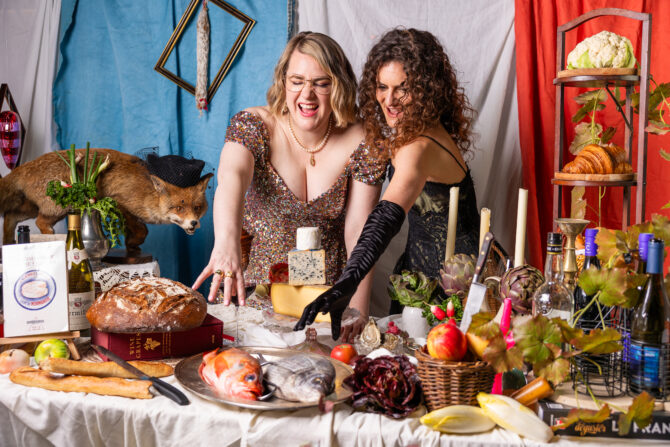
We meet Caroline Fazeli and Emily Monaco, hosts of The Fishwives of Paris, a podcast that cuts through clichés about French cuisine. Combining Lyon-based wine expertise with Paris food journalism, they serve sharp humour, strong research and deep gastronomic insight as they tackle the truths behind France’s most iconic dishes.
How did you get together in the first place and come up with the idea for this podcast?
Emily: We met online through a former podcast project, and while we spent hours chatting about French food and wine – and while I even dog-sat for Caroline’s darling pup Buffy for a month – we didn’t actually meet IRL for several years! The idea of collaborating on a project that reflected our brazen, kind of insolent, truth-driven approach to French food and wine had nevertheless been simmering in the background, and last year, we came up with the idea of this podcast. Caroline came up with the name, a reference to our slightly salty, no-holds-barred approach to flipping the tables on myths about French food and wine.
Tell us a little bit about your backgrounds and your relationship/history with French food.
Caroline: I’ve been in Europe for more than half my life, but my inroad into wine was when I was doing my undergraduate degree at Oxford. I was studying archaeology and anthropology, and I started doing competitive blind tastings – I was even top taster! Later, I studied cooking at the Cordon Bleu, and then I settled here in Lyon – for good! – in 2017. Now, I’m the owner of Lyon Wine Tastings, a boutique wine tasting company offering wine tastings in English to tourists.
Emily: I moved to Paris as a student in 2007, and I’ve been here ever since! Originally, my interest in food and wine was more of a hobby. On previous visits to France, I’d noticed how much everyone in France really cares about food – and not just foodies. It seemed like a good way to integrate more fully into the local culture. I started frequenting markets and chatting with cheesemongers, and once I graduated, marrying my passion and knowledge for French food with my degree in journalism seemed to be the next logical step!
You describe the podcast as ‘flipping the table on French food mythology’. Which myth gave you the most pleasure to expose — and did it surprise you too?
Caroline: I think the baguette myths are super good… but I actually really enjoyed beef bourguignon. That was a big one for me. French people are going to be mad about that one when it comes out!
Emily: I also really love the baguette myths – there’s a reason we picked that one for our first episode. But I think that the one I loved exposing the most was the myth about Camembert, just because it has so many layers. So many Americans think that the most emblematic soft cheese in France is Brie, whereas here, Brie is really more of a Parisian cheese. Camembert is the one that’s really representative of French identity, but the reasons why are complex and usually misunderstood. And I loved that we were able to explore how prevalent industrial Camembert is to shine a light on the really good ones.
Each episode takes aim at a different food legend. Which topic has provoked the liveliest debate among your listeners so far?
Caroline: Honestly, bacon! French people don’t like us talking about their food, and they really didn’t like what we had to say about French bacon not being good. What can we say? It’s hard to beat Neiman Ranch.
Emily: There was also a pretty big debate early on about whether the word miche (sourdough loaf) is slang for boobs or butt. The conversation got heated.
What do you think are the most common misconceptions about French gastronomy?
Caroline: That French people eat really well all the time, and there’s no industrial food here. That’s just not true. There’s a lot of bad food here.
Emily: And France’s food has been heavily industrialised for a long time – over a century. It’s not new, but we are focusing on it more now, and the conversation around it is changing.
What is your favourite French dish to order in a restaurant and which is your favourite to make at home – and why?
Caroline: Escargots is something that I would definitely order, and I love. Because yeah… I’m not making that at home. And then something that I would make at home that’s very Frenchie is beef bourguignon. It’s easy to make. It takes a while, but it’s easy.
Emily: And see, in a restaurant, I love ordering slow-cooked meat dishes – not because I can’t make them, but because I don’t. My girlfriend is vegetarian, so I don’t cook meat at home. And honestly, I rarely cook French food at all, just because I eat it so much when I’m out! My go-tos at home are usually Chinese, Indian, and Korean. That said, I have a soft spot for a baked Mont d’Or in winter. I usually serve it with potatoes, Brussels sprouts, and roasted root veggies.
If you had to choose one dish or ingredient that sums up your love of French food, what would it be, and why?
Caroline: Butter or bread, honestly. The bread here is so good. And butter… butter is in everything delicious. It just makes everything taste better! Especially French butter. I would so much rather eat good butter and cook with good butter and not freak out about it.
Emily: I can’t not say cheese. Terroir is so important in France – it’s something we talk about loads on the podcast. And French cheese is innately reflective of the local terroir and the local people. Every tiny area of France has its own cheese, and each cheese tells a story. Were the local people poor or wealthy? Is the region made up of mountains or pasture? Were there monks in the vicinity? You can tell so much about an area through its cheese. And with 1,800 cheeses in France, there are so many different ones to discover.
What and where is your favourite French restaurant?
Caroline: I really love Café Terroir in Lyon. It’s sort of an elevated bouchon. I love the tableside carving, which you don’t see that often anymore. It’s just delightful, honestly. And it does seem like kind of a lost art.
Emily: The most exceptional dining experience I’ve ever had was at two-Michelin-starred Bernard Loiseau in Burgundy. I went there by myself, and I had the full tasting menu, and between the dining room and the setting and the service and the food… It was a once-in-a-lifetime experience. But the place I go back to time and again is Chez Georges in Paris. It’s an old-school bistro where the food is good, the service is pleasantly gruff, and the dining room seems like it’s from another time. It’s funny, because there are places where the food is even better, but the ambiance there really makes it. Also, the frisée aux lardons is insane.
What’s next for the Fishwives?
Caroline: We’re currently working on Season 2, where we’ll be flipping the tables on even more French myths. But in the meantime, we really want to encourage our community to continue to grow. We’ve naturally found our way into the ears of people who are curious about the truth behind French food, and we want to give them more avenues to do that, whether it’s with cool branded merch or Fishwives trips and tours. There are so many possibilities, and we’re excited to see what vibes with our audience.
Share to: Facebook Twitter LinkedIn Email
More in Fishwives of Paris, Food podcasts, French food
Related Posts