Géraldine Leverd: An Interview with La Cuisine de Géraldine
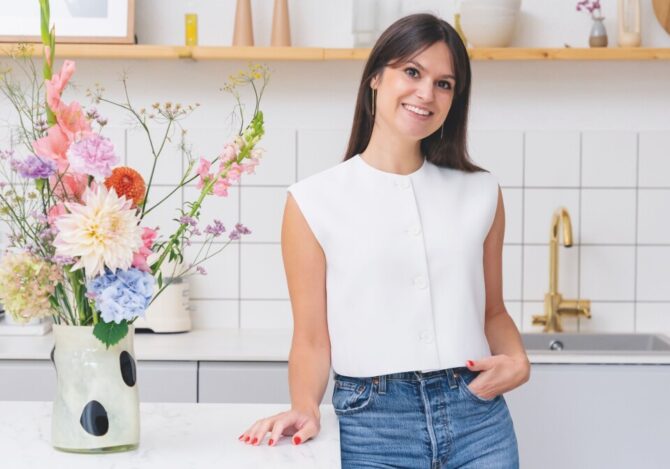
Géraldine Leverd is the author and recipe developer of La Cuisine de Géraldine, as well as a French blogger, influencer, and food photographer based in Düsseldorf, Germany. Géraldine brings a fresh, modern approach to traditional French cuisine, and through her platform La Cuisine de Géraldine, she shares accessible, healthy, and beautifully photographed recipes that celebrate quality ingredients and the simplicity of everyday cooking.
What began as a childhood passion has grown into a full-time profession, with millions visiting her blog each year and a community of over 500,000 followers on Instagram. Géraldine’s colourful, contemporary style and engaging social media presence invite food lovers to (re)discover the authentic flavors of French gastronomy – proving that French cuisine can be easy, fast, and modern, without losing its soul.
What’s your earliest food memory that sparked your passion for cooking?
I have lots of memories that my parents would tell me – we all love food, it’s in the family. When I would get back from school, the first question I always asked was, “what are we eating?” It was the most important question – I was obsessed with what we were going to eat.
I’m very lucky because my mom was always cooking, even if she had a full time job, like a typical French woman. She would cook every night.
My mom would pick me up from school and I would give ideas for dinner. She would then take me to the grocery store and we would cook together. I loved that and I still love it.
My parents were always excited about food, especially when something was in season or specific to a particular region. It was a big deal – like, “Here, we can try the crab from Arcachon,” or the oysters. But it wasn’t just about fancy food. We also loved simple things – like escargots, or enjoying a simple meal at a little mountain restaurant after a hike. Every food was interesting from the more basic to the more fancy.
What inspired you to start sharing your recipes online? And did you ever imagine building the following that you’ve got now?
No, I really didn’t. I think the fact that I live abroad, as I now live in Germany, really showed me what I had at home was not normal for everyone – not everyone cooks a dinner every evening, not everyone is used to doing the groceries. And at the beginning when I started to share, I didn’t have a full recipe. I would cook like my mom would – I bought ingredients and I put everything together and it made a dish. So that’s what I learned.
But I was already very interested in the world of gastronomy because I worked in the wine industry for seven years. I was part of the biggest trade fair for wines and spirits here in Dusseldorf, Germany, where I live. When the pandemic started, my job was very impacted because I was organising this big event. And for two years, there was no event. And the first thing I thought was something I always wanted to do – I started the blog. I put the recipes online as early as I did on Instagram.
But I did that for friends and family because my friends would always ask me, what is your tapenade recipe? What is your this and that recipe? So I just started it more for my friends. I thought, like everyone did, that the pandemic would last for two months and then I would go back to work. But then two things happened … First, the pandemic didn’t end after 2 months, so I had more and more time to focus on recipe development. And secondly, I also started to love not only cooking, but the sharing, the writing down recipes, researching, trying to see what I can do next – how can I go deeper and deeper into French cuisine? And of course then taking photos. I took many classes to get better in photography because you eat with your eyes. We say that in French too.
You describe your mission as showing that French cuisine can be easy, it can be healthy, it can be fast. I think a big misconception is that people think that French food is very complicated and time consuming because it’s regarded as the best food in the world. So how do you simplify these recipes into quicker, healthier ones, without losing their French soul?
I’m someone that is a bit lazy. So if I see a recipe that says you have to do this and that, I’m like, I’m never going to do that. I’m going to do that maybe once in my life, but never again. And I don’t want that for my cooking. So I started to think, what do you know from another recipe? How can you turn it? Or maybe like I really try to take only the fresh ingredients to start from scratch. But there’s a few things that I will use because I think these few things are okay. If you choose quite good quality, it’s the broth. So with lots of recipes, I just simplify them by using ready-made broth or stock.
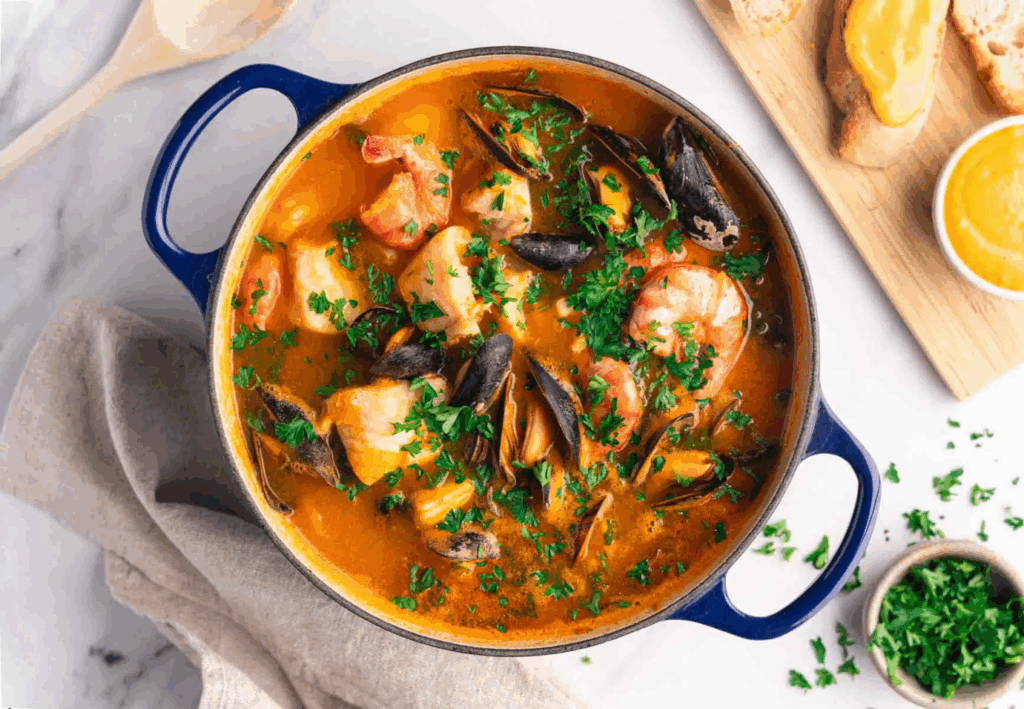
I went to culinary school and learnt the basis of French cuisine. So I learned how to make stock. I can do the stocks. But I know that unless you are a big restaurant and you can have your stock on the stove the whole day because you need to make lots of recipes, it’s often so much work to make just 1 cup of stock. So I think that’s the only ingredient I use that is okay to not use completely fresh. There are good qualities now. I’m thinking about the bouillabaisse. Like the true bouillabaisse, you have to take the fish heads and fish bones and you make your stock. And honestly from time to time it’s nice. But if you want to make just a quick fish soup, like I prefer to serve a quick fish soup and have one starter, and one dessert. There are more things to do than to spend the whole day making one dish.
That’s actually how I simplify recipes, I would say. But in terms of cooking, like cooking time, things in the oven like beef bourguignon, you don’t really need to simplify because the recipe, if it’s well explained, it’s just not that complicated.
And talking about bouillabaisse, is there one regional French dish that you think should have more of a spotlight, perhaps something that you’ve tried and loved but you don’t think as many people know about?
Oh, so many. Panisse is a nice recipe that no one remembers – it’s a French Provencal dish made from chickpea flour. For me, it’s a good example of an old dish that is actually super healthy. It’s gluten free and it can be made vegan. It’s just some fries that you can make with chickpea flour.
I haven’t tried that! So I’m going to have to follow your recipe for it. Congratulations on your cookbook. That is so exciting. Was it always your dream to write a cookbook?
I should answer yes, but honestly, if you asked me six years ago, I would not have even dreamt of it. But then, after a few years, when I started to develop recipes to have a blog, I was like, wow, yeah, one day I would like to have my cookbook.
But at the beginning, I had another plan for my life and I’m just super excited it turned out this way. It was my decision, I worked for it. But at the beginning, like six years ago, I didn’t know.
Social media is so recent. I would not have imagined that I could become an influencer and be someone in the cooking world. For me, that role was reserved for big chefs with restaurants, then I was like okay, you can have your own space with your own personality.
What kind of recipes can a reader expect in your book? And are there any that are particularly personal to you?
One recipe that my uncle would do the whole time is a tapenade, which is a classic.
I was always making the gougère as well. One of my first recipes that I remember cooking on my own was gougère. So it’s here in the book.
Then the crème brûlée, because it’s my grandmother’s favourite. But I make it a little differently. I add my personal touch, with some cardamom, because it’s a spice that I really love. Sometimes I make a little twist, because I like the twist. Sometimes I keep it classic.
In the book, the tarte au citron, that’s just my favorite thing in a bakery. So I thought it had to be in the book. And sometimes I just want the classic – not too fancy, because it’s just so powerful the way it is.
The Moelleux au Chocolat is also one of the first, because it’s a recipe I’ve been doing for years. I don’t need the recipe. I just make it and then I bake it in the oven, and everyone likes it.
And so, for someone who’s new to French cooking, which recipes of yours would you recommend that they start with? What would be a good introduction to French cuisine?
It’s always difficult to say if someone wants something with meat or no meat. I have many followers that follow me because they are vegetarian. And depending also on the level of skills, I would definitely say just try the boeuf bourguignon, because everyone thinks it’s complicated, but it’s not complicated.
And then when you can do this, you can do almost every dish that is stew, because it’s almost the same concept, just mixing, and replacing the wine with something else.
And for the vegetarian on the block, I have a vegetarian bourguignon mushrooms. So maybe that’s just a good start for something. Like, if you want to spend one, not one day but like a few hours, invite some guests. That’s a classic. But that’s the one you should try.
So what would be your go to like pantry staples for French cuisine? You’ve said a good broth is essential. What other herbs, spices, anything would you say central for a French cooking cupboard?
I use lots of fresh herbs like thyme and rosemary – it makes such a difference. But you can also have them dry. I also have a recipe for herbes de Provence. Just put some potatoes and some herbes de provence with olive oil, and that’s it. But you can also make your own herbs so that you have your own mix. I always have it in my pantry.
Of course I use butter and creme fraiche. But a bit less than usual. That’s why French cuisine is known to be heavy, because all the sauces are reduced with lots of butter. But more and more young chefs try to find other ways. Working with herbs really adds flavour without using only butter. So that’s also what I try to do.
So I replace it with lots of herbs and spices to make a dish flavourful without the butter or the fat. But I still use a lot of butter and creme fraiche. And I would say wholegrain Dijon mustard is the one I love to use for every vinaigrette and sauce.
That leads me on perfectly because what I was going to ask you – when you return to France, what are the ingredients you’re buying in France that you’re definitely taking back to Germany?
Real whole grain Dijon mustard. And of course, olive oil. Anytime I’m in the south of France, I buy a good olive oil. I always bring also the Piment d’Espelette, which is a spice you can never find except from in France. It’s this mild chilli pepper from Basque country in France. And it’s super nice. French cuisine is not too spicy, but you can always add it, especially with eggs.
Would you ever dream of opening a restaurant or a cafe? Is that something you’d consider?
Yeah, I like them. I like hosting. So what I’m thinking I would love to either do something like a pop up just for like a few days, or there’s this trend of hosting dinners. Like really, you host dinners for, for 15 people? Because I think what I love is really sharing, sharing the recipes, sitting with my guests.
So instead of having a restaurant where I would be in the kitchen and there is this barrier, I would love to basically have a big dinner in the form of a pop up in a restaurant or just a big dinner party where I invite guests. That it’s a concept that is maybe a bit more modern and new, but I find it interesting.
And then talking of restaurants, what is your favourite restaurant in France?
The problem is that I’m in Paris every two or three months and there is always a new restaurant opening with new chefs that have new concepts. I’ve made a guide with more than 70 addresses in Paris including restaurants and bakeries and it’s always changing. It’s hard to choose a specific restaurant, but the place to try good food for me is definitely Paris. It’s a place where young chefs are trying new things. There are new restaurant concepts there – I see lots of inspiration for more modern French food.
Is there one kitchen gadget that you couldn’t live without?
The garlic press.
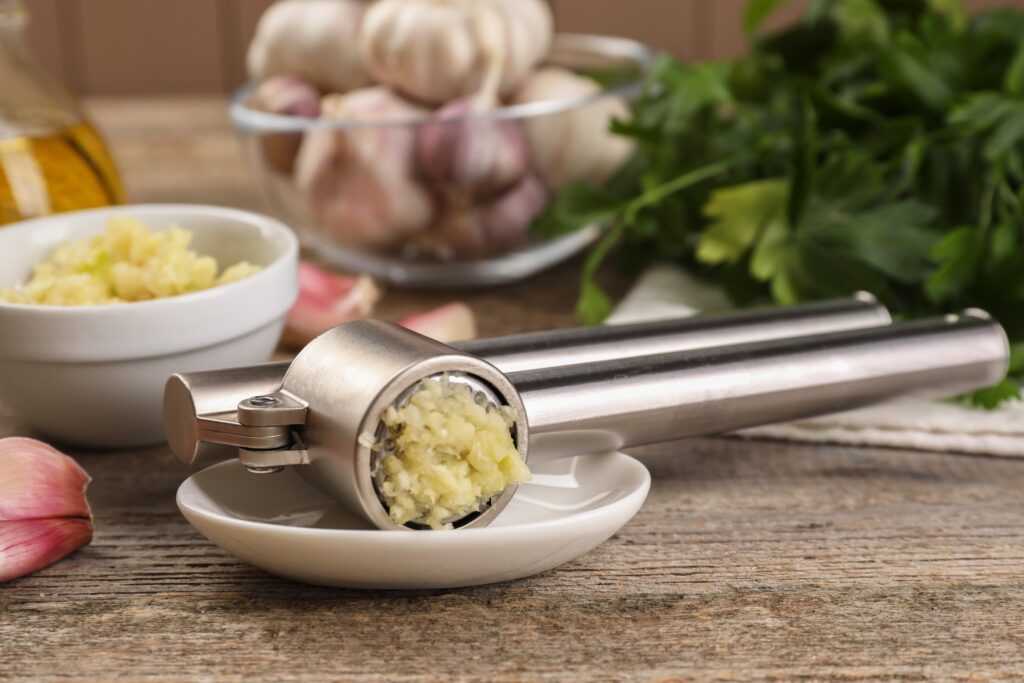
I learned from my mom how to cook with one wooden board and one knife and one fork. My mom never even used a whisk – she used a fork. I learned how to cook with not much equipment. I have more equipment now than my mom, but I want to try to show that it’s still possible without. You can do lots without equipment.
Share to: Facebook Twitter LinkedIn Email
More in Chef, Geraldine Leverd, Interview, Traditional Recipes
Related Posts